Jackson Phil Collen PC1-E
PHIL’S LATEST RIFF
The Jackson PC1-E is not a typical signature guitar. The Phil Collen PC1 has never been one either. Since Jackson and Def Leppard guitarist Phil Collen established the model, the PC1 has combined familiar Jackson performance hardware with a specification sheet that follows Collen’s preferences rather than simply dressing up an existing production model.
The Jackson Pro Series Phil Collen PC1-E takes that idea in a different direction. This is a Mexico made version of the PC1, placing it below the USA built models while retaining the core ingredients that make the PC1 what it is: the Dinky body shape, 24 fret neck, Floyd Rose tremolo, Sustainer equipped electronics and a pickup configuration built around Phil Collen’s preferences.
This is also my fourth Phil Collen model, so I have some history with the PC1 formula. That makes the changes here more interesting than simply comparing a new guitar to a specification sheet. The PC1-E changes some of the familiar ingredients while keeping the basic recipe intact.
The biggest change is the neck. Jackson moves away from the oversized neck associated with earlier PC1 models and gives the PC1-E a more conventional profile. The body changes as well, using mahogany without the maple top found on previous versions. The electronics receive their own update, with an X2N bridge pickup, Sugar Chakra middle pickup and a newer Sustainer configuration.
The result is a PC1 that feels considerably more approachable without losing the personality that makes the model worth knowing.

FROM PHIL TO PC1-E
The history of the PC1 gets a little complicated because Jackson has produced several guitars carrying the Phil Collen name.
The original Phil Collen signature appeared in the late 1980s and used a very different construction, including an archtop design and neck through construction. That guitar belongs to a different chapter of the PC1 story.
The modern PC1 formula begins around 1996. This is the version that establishes the familiar Dinky style body, bolt on neck, 24 frets, Floyd Rose tremolo, five way switching and Sustainer system that define the model today.
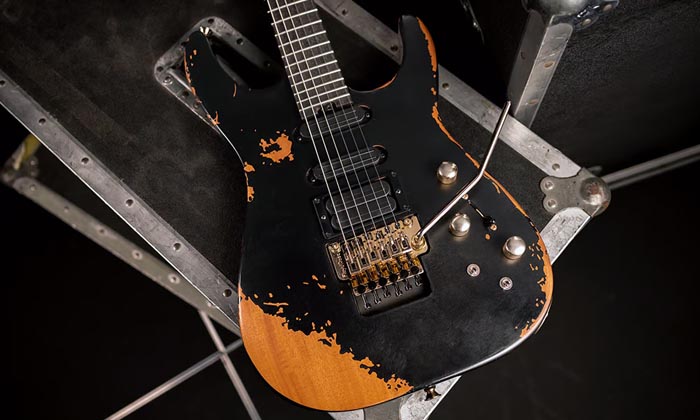
The PC1-E follows that modern formula while changing several of its details. It uses a mahogany Dinky body with a distressed Worn Black nitrocellulose finish, a caramelized maple neck and ebony fingerboard with a 12-16″ compound radius. The 25-1/2″ scale and 24 fret layout remain firmly in Jackson territory.
The electronics also stay true to the PC1 concept while taking a different route. The bridge gets a DiMarzio X2N, the middle position uses a Sugar Chakra and the neck position is occupied by the PC1 Sustainer Driver.
It is not simply a less expensive version of a USA PC1. It is a different interpretation of the model.

READY TO ROCK
The first thing worth mentioning about the PC1-E is what happened before I plugged it in.
The guitar arrived remarkably close to where I would want it from the factory. The action was right where it needed to be, including down at the first fret, and the neck relief was already in good shape. The pickup height was also properly set, so there was no immediate need to start turning screws just to get the guitar into evaluation territory.
That matters because the retailer I deal with specifically does not adjust guitars before shipping them. They will not turn a screw, alter the setup or otherwise modify the instrument because the guitar is going to be evaluated in a way that ultimately reflects on the manufacturer. So what arrived at the door was essentially what Jackson shipped.
The only adjustment I would make involved the claw screws for the Floyd Rose 1000 tremolo. A small tweak would have brought the bridge into a better level position, but that is a minor setup adjustment rather than something that made the guitar difficult to play. Everything else was remarkably close.
The action remained comfortable along the neck, including the first fret, without requiring the sort of immediate setup work that sometimes accompanies a brand new guitar. The neck relief was right, the pickups were sitting at sensible heights and the guitar felt ready to play rather than ready to visit the workbench.
For an evaluation guitar, that is exactly what I want to see.

COMIN’ UNDER FIRE
THE PC1 GETS A NEW NECK
The neck is probably the most noticeable change for anyone familiar with the traditional PC1.
Earlier PC1 models are known for their substantial neck profile. The PC1-E takes a different approach with a caramelized maple neck that feels much closer to a conventional Jackson neck.
That makes the guitar easier to approach if the larger PC1 neck has never been your thing. The profile feels familiar without becoming generic, and the 12 to 16 inch compound radius provides the expected combination of comfortable chording toward the lower frets and a flatter platform for lead work farther up the neck.
The caramelized maple construction also fits the overall character of the guitar. It looks right with the distressed finish, but this is not a case where the appearance is doing all the work. The neck feels stable and straightforward, with none of the adjustment drama that can turn a new guitar into a setup project.

MAHOGANY WITHOUT THE MAPLE TOP
The PC1-E also changes the body recipe. Instead of the familiar maple topped construction, this version uses a mahogany body without the maple top. That gives the guitar a different visual identity, particularly underneath the Worn Black distressed nitrocellulose finish.
More importantly, it changes the emphasis of the instrument without turning it into something unrecognizable.
The PC1 has always had plenty of hardware and electronics competing for attention, so the body does not need to reinvent the guitar. The mahogany construction gives the PC1-E its own place within the lineup while leaving the neck, bridge and electronics to deliver much of the familiar PC1 character. That is a sensible approach for a model that already has plenty going on.

X2N, SUGAR CHAKRA AND SUSTAINER
The pickup combination is where the PC1-E gets serious. The DiMarzio X2N in the bridge is not a subtle pickup. It delivers the aggressive output expected from the model while giving the PC1-E a bridge position that has plenty of authority for heavier sounds. The Sugar Chakra in the middle position provides a different voice and gives the five way selector some useful contrast rather than simply functioning as a decorative middle pickup.
Then there is the Sustainer. The PC1 has long been associated with a Sustainer system, but the PC1-E uses the newer configuration that gives the guitar a little more flexibility than the older versions I have encountered. That remains one of the defining reasons to buy a PC1 in the first place. You are not simply getting another humbucker equipped superstrat. You are getting an electronic system capable of turning sustained notes into something considerably more dramatic.
The combination makes the electronics one of the strongest parts of the PC1-E’s personality. The bridge pickup brings the fire, the middle pickup provides another useful voice and the Sustainer remains the party trick that no ordinary pickup can duplicate.

FLOYD ROSE 1000 GETS THE JOB DONE
The Floyd Rose 1000 is a familiar choice for this type of guitar, and it makes sense here. The system gives the PC1-E the range needed for everything from subtle vibrato to the sort of abuse that comes naturally with a Phil Collen signature model. The only adjustment I would make out of the box is leveling the tremolo slightly with the claw screws. That is a setup detail, not a condemnation of the bridge.
Once properly leveled, the Floyd Rose 1000 does exactly what it is supposed to do. It gives the guitar the tuning stability and pitch manipulation that are fundamental to the PC1 formula without introducing some exotic proprietary system that requires learning a completely different maintenance routine.
For a guitar built around high gain sounds, a Sustainer and Phil Collen’s playing style, the Floyd is right at home.

PLAYABILITY WHERE IT COUNTS
The PC1-E’s playability ties the changes together. The neck profile is easier to settle into than the traditional PC1 neck, the compound radius works naturally across the fingerboard and the action arrived low enough to make the guitar immediately usable.
The first fret is worth mentioning because that is often where an otherwise good factory setup reveals itself. Here, it did not. There is a difference between a guitar that has been made playable and one that arrives feeling properly sorted. The PC1-E falls into the second category.
That makes the guitar particularly interesting because the changes do not seem aimed at making the PC1 more complicated. They make the instrument easier to pick up and play while retaining the hardware and electronics that give the model its identity.

SPECS
Body Mahogany
Finish Distressed Nitrocellulose Lacquer
Material Mahogany
Shape Dinky
Color Worn Black
Orientation Right-Hand
Platform Artist
Product Name Pro Series Signature Phil Collen PC1-E, Ebony Fingerboard, Worn Black
Series Artist Signature
Controls Volume (push-pull coil split), Tone, Intensity Control, Active Sustainer On/Off Switch, Fundamental/Harmonic/Blend Switch
Bridge Pickup DiMarzio X2N DP102
Middle Pickup DiMarzio Sugar Chakra DP427BK
Neck Pickup PC1 Sustainer Driver
Pickup Configuration HSS
Special Electronics 18-Volt Jackson Sustainer System
Switching 5-Position Blade: Position 1. Bridge Pickup, Position 2. Bridge and Middle Pickup, Position 3. Middle Pickup, Position 4. Middle and Neck Pickup, Position 5. Neck Pickup
Pickguard None
Pickup Covers Black
Style 2 Single-Coil / 1 Humbucking
Bridge Floyd Rose 1000 Series Double-Locking Tremolo (Recessed)
Control Knobs Dome-Style
Hardware Finish Gold
Neck Plate 4-Bolt
Strings Nickel Plated Steel (.009-.042 Gauges)
Tremolo Arm Floyd Rose 1000 Series Locking
Tuning Machines Jackson Sealed Die-Cast Locking
Fret Size Jumbo
Scale Length 25.5″ (648 mm)
Fingerboard Material Ebony
Fingerboard Radius 12″ to 16″ Compound Radius (304.8 mm to 406.4 mm)
Headstock Licensed Reversed Fender Stratocaster®
Neck Construction Bolt-On with Graphite Reinforcement
Neck Finish Oiled
Material Caramelized Maple
Number of Frets 24
Nut Material Floyd Rose 1000 Series Locking
Nut Width 1.6875″ (42.86 mm)
Position Inlays Single Pearloid Sharkfin at 12th fret
Side Dots Luminlay®
String Nut Floyd Rose® 1000 Series Locking
Truss Rod Dual-Action with Wheel
DEMO
MORE GAS IN THE TANK
The push pull coil split on the volume control is one of the most overlooked opportunities on the PC1 as a line of guitars.
The feature itself is useful. Pull the volume knob and the X2N bridge pickup splits, opening another sound beyond the full humbucker configuration. The problem is that the X2N is still the X2N. Even split, it remains a flamethrower. That does not make the coil split pointless. It simply means there is more versatility sitting inside the five way switching system that Jackson could have exploited.
I have added this modification to one of my older PC1 models, and the approach makes sense here as well. A push pull pot can be wired so that the middle Sugar Chakra pickup also participates in the split arrangement.
That becomes particularly interesting in positions 2 and 4. Instead of limiting the split function to the bridge X2N, splitting the middle position as part of the switching combinations would create additional tonal options from the existing pickup set. The guitar already has the hardware needed to make those sounds possible. It would simply take a little more wiring.
This is also not some modification that requires a laboratory full of specialized equipment. Anyone with a reasonable level of guitar tech ability can handle the wiring. Even if Jackson chooses not to build the additional switching into the production model, it is an easy upgrade for an owner who wants to explore what the PC1-E’s electronics can really do.
For me, that is the bigger missed opportunity. The PC1-E already has a lot of electronics packed into the guitar. The coil split could simply take better advantage of what is already there.

CONCLUSION
The Jackson Pro Series Phil Collen PC1-E takes the familiar PC1 formula and gives it a more accessible personality. The changes are substantial enough to make this version feel distinct, but the guitar still has the hardware and attitude expected from a Phil Collen signature model.
The X2N, Sugar Chakra, Sustainer and Floyd Rose 1000 give it plenty of firepower, while the overall package feels less specialized than some of the earlier PC1 versions.
After spending time with several versions of the PC1, the PC1-E feels like a genuine evolution of the formula rather than simply a lower priced version of what came before. It still has Phil Collen written all over it, but this one may have a broader appeal for players who never quite clicked with the traditional PC1.
For reference, this Jackson Pro Series Phil Collen PC1-E guitar evaluation was conducted with the following: Fractal Axe-Fx II XL+ featuring Celestion Impluse Responses and Fractal MFC-101 MIDI Foot Controller. ADA MP-1 Tube Pre-Amp loaded with Tube Amp Doctor ECC83 Premium Selected tubes, using the ADA MC-1 MIDI Controller. Fryette LX II Stereo Tube Power Amplifier. Physical cabs in use are Marshall 1960B, Mojotone British, and Peavey 6505 cabs loaded with Celestion Classic Series Vintage 30s and Classic Series G12M Greenbacks.
Jackson Guitars Website | Facebook | Twitter | YouTube | Instagram
7 string 59 Airbucker Alnico 2 Alnico 4 Alnico 5 Alnico 8 Artist Signature Bare Knuckle BKP Brown Sound Celestion Ceramic Charvel Custom Shop David Shepherd DiMarzio Dual Resonance Edge EVH Fishman Floyd Rose Gibson HSP90 Humbucker Ibanez JB Jimmy Page John Petrucci MJ Mojotone P90 PAF Pariah Pickup Rail Satch Seymour Duncan Singlecoil Single Width Speaker Steve Vai Tech Tip Tremolo Virtual Vintage