ESP LTD Horizon Custom ’87
The ’80s Called. ESP Answered.
The late 1980s and early 1990s were a particularly interesting period for electric guitar design. The market was full of instruments aimed at players who wanted speed, sustain, tremolo abuse and enough output to make a Marshall stack reconsider its life choices. ESP was right in the middle of that movement, and the Horizon became one of the company’s signature high-performance designs.
In 2024, ESP brought the late-’80s version of the Horizon into the LTD ’87 Series with the Horizon Custom ’87. The model joined the company’s ’87 Series, which draws from some of ESP’s most recognizable instruments of that era. The formula is deliberately familiar: an archtop body, neck-thru construction, a three-piece maple neck, Macassar ebony fingerboard, 24 extra-jumbo frets, Floyd Rose tremolo and premier pickups.
There is a particularly good reason for me to take a close look at this guitar. I bought a Kramer Stagemaster Deluxe I new in 1989 and have more than 35 years of experience with this particular body style and general approach to this guitar design. The relationship between the ESP Horizon and Kramer Stagemaster is also part of the history of these instruments that deserves more attention than it usually receives.
The Horizon Custom ’87 is not simply another retro-styled shred guitar passing through the Darth Phineas review department. It is a modern LTD interpretation of a guitar design I have known since these instruments were actually new, which gives me a rather useful reference point for evaluating it.
ESP, Kramer and the Original Horizon
The history of the ESP Horizon and Kramer Stagemaster goes back to a period when ESP was becoming increasingly important as an OEM manufacturer as well as a guitar brand in its own right. ESP supplied Kramer with necks and bodies that Kramer incorporated into its instruments and assembled at the company’s New Jersey operation.
The Stagemaster was somewhat different from the typical arrangement. Among the instruments ESP produced for Kramer, the Stagemaster was one of the models that ESP shipped as a substantially completed instrument, ready for Kramer to sell. That distinction matters when looking at the similarities between the Stagemaster and Horizon. These guitars were not simply two companies independently arriving at a similar Super Strat design.
The Family Resemblance
Put an original late-’80s ESP Horizon next to a Kramer Stagemaster and the family resemblance is immediately apparent. The archtop body, proportions, contours and overall silhouette are remarkably close. These were not simply two companies arriving independently at similar ideas; the connection between ESP and Kramer helps explain why the two instruments share so much of the same design language.
The ESP Horizon itself developed a substantial reputation during the period. These were serious professional instruments at a time when ESP built guitars for players who demanded considerably more from their instruments than the average Stratocaster or Les Paul specification provided. Michael Wilton of Queensrÿche was one of the more visible Horizon users, especially during the Operation: Mindcrime era. The guitar received plenty of exposure in the hands of a player who knew exactly what he wanted from a high-performance instrument.
ESP also has the advantage of never really abandoning the Horizon. While Kramer eventually moved in other directions and the original Stagemaster became a vintage instrument, ESP continued producing Horizon models.
That continuity matters with the LTD Horizon Custom ’87. ESP did not have to recreate the model solely from old photographs and catalog pages. The company has continued to understand the Horizon as part of its own product history.
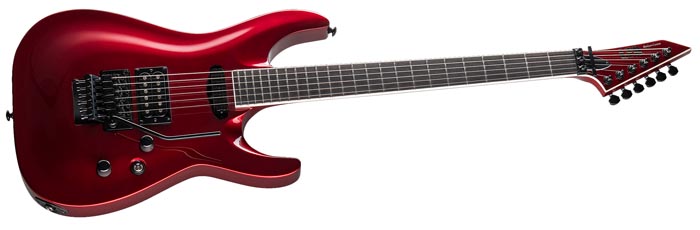
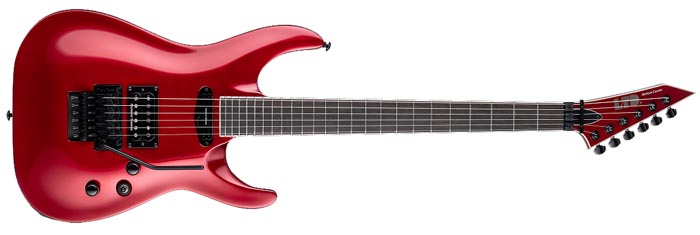
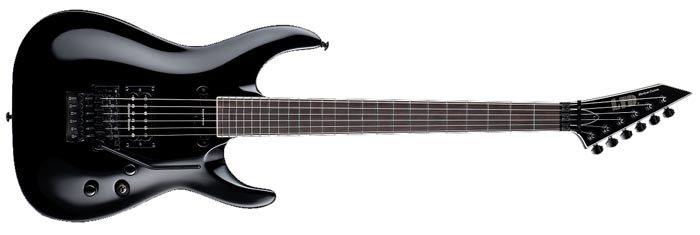
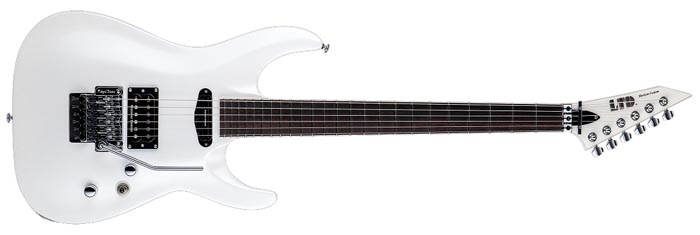
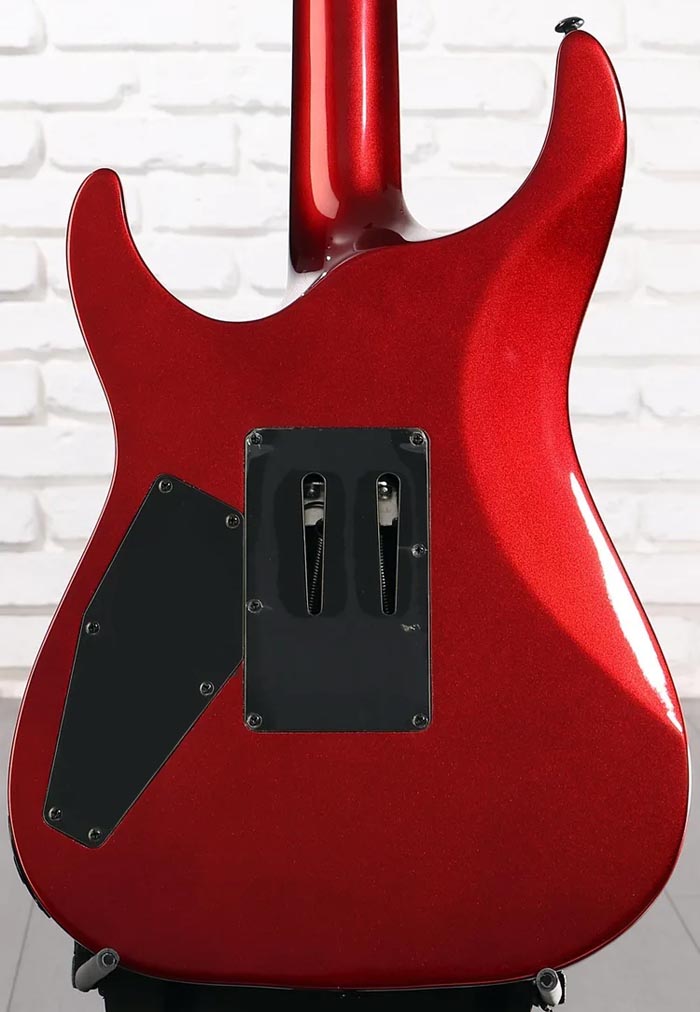
The 2024 Horizon Custom ’87 came in Black, Candy Apple Red and Pearl White. The Black and Candy Apple Red versions use black hardware, while the Pearl White version receives chrome hardware. For me, I am going with the Candy Apple Red version.
FIRST IMPRESSIONS — A Very Good Start
The circumstances surrounding this particular guitar are worth mentioning because they are part of the reason it ended up here in the first place.
By June 2026, the Horizon Custom ’87 is starting to phase out of production. One retailer reduced the price by $600, and at that point the decision became considerably easier. A guitar with this specification and history was already interesting; at $600 off, it was difficult to justify leaving it behind.
The guitar’s condition upon arrival made the purchase look even better.
One of the frustrations of buying guitars, including some fairly mid-level guitars, is that “factory setup” can mean anything from genuinely ready to play to “the strings are installed and the instrument technically produces sound.” Shipping, changes in temperature and humidity, and the realities of production can all mean that a new guitar needs some attention before it performs at its best.
This Horizon Custom ’87 did not need that attention. The setup was exceptionally good straight out of the box. The neck, frets, action and the Floyd Rose are all in the sort of condition that allowed me to pick up the guitar and start evaluating it rather than immediately reaching for tools.
In more than three decades of buying and playing guitars, there have probably been five or fewer instruments that arrived this ready to go from an online retailer. That is a surprisingly short list considering how many guitars have passed through my hands.
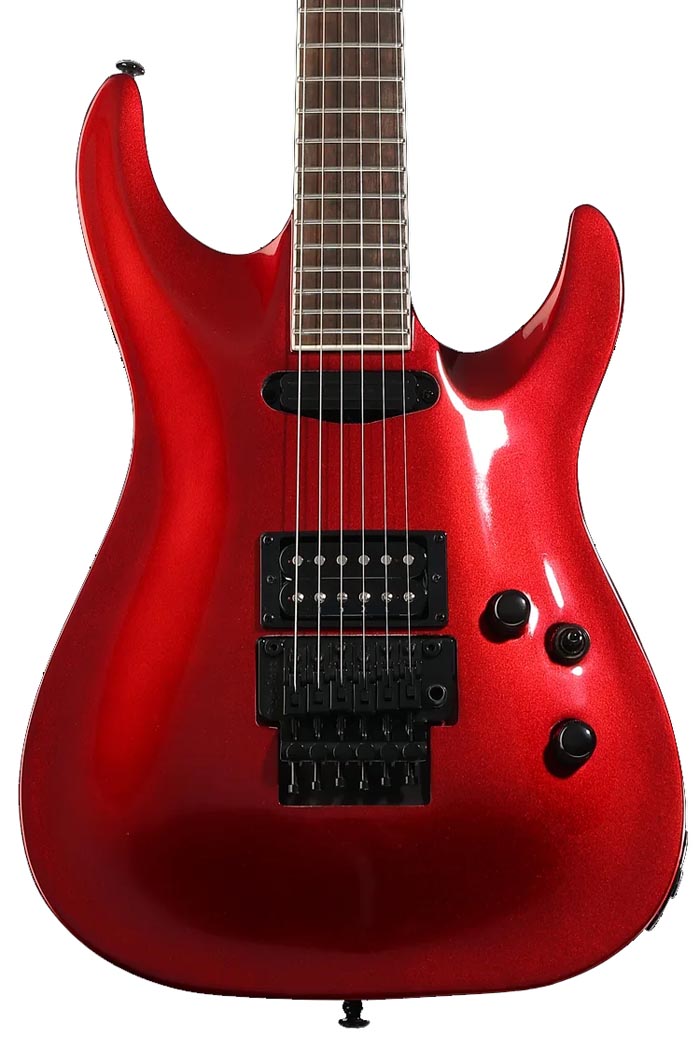
The Candy Apple Red finish also works extremely well with the design. Paired with the black hardware, it has the right visual connection to the late-’80s Horizon without becoming an exaggerated reproduction of a hair-metal prop. The body shape remains distinctive, while the relatively restrained presentation keeps the attention on the instrument itself.
BODY — The Horizon Carve
The body is where the LTD Horizon Custom ’87 separates itself from the many generic Super Strat designs that have appeared over the years.
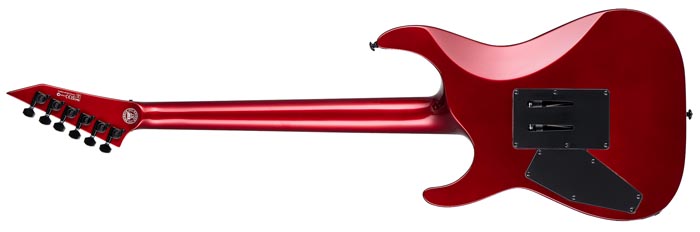
ESP retained the archtop construction of the original Horizon rather than flattening the body into a more conventional modern shred guitar. The body is alder, and the neck-thru construction extends the three-piece maple neck through the body rather than attaching it as a conventional bolt-on.
The archtop gives the guitar a different visual character from the flat-top instruments that dominated much of the high-performance market. It is also one of the details that makes the Horizon recognizable even when the headstock is not visible.
The overall proportions are equally familiar to anyone who knows the original guitars. This becomes particularly apparent when comparing the LTD with an original Kramer Stagemaster. After living with a Stagemaster since 1989, I can recognize the basic design language without having to consult a tape measure.
The lower bout, horns, top carve and overall body proportions have the same general character as the original Horizon. The LTD does not look like someone took a contemporary Super Strat and added a decorative top in an attempt to make it resemble an older ESP.
The lack of excessive decoration is also appropriate. The original Horizon had a straightforward visual presentation, and the ’87 Series version follows that philosophy. There are no unnecessary graphics or elaborate appointments competing with the shape of the instrument.
The result is a guitar that looks distinctly late-’80s without looking dated. Plenty of guitars from that period should remain exactly where they are: in old music videos and someone’s attic. The Horizon is not one of them.
NECK/FRETS — Built for the Upper Register
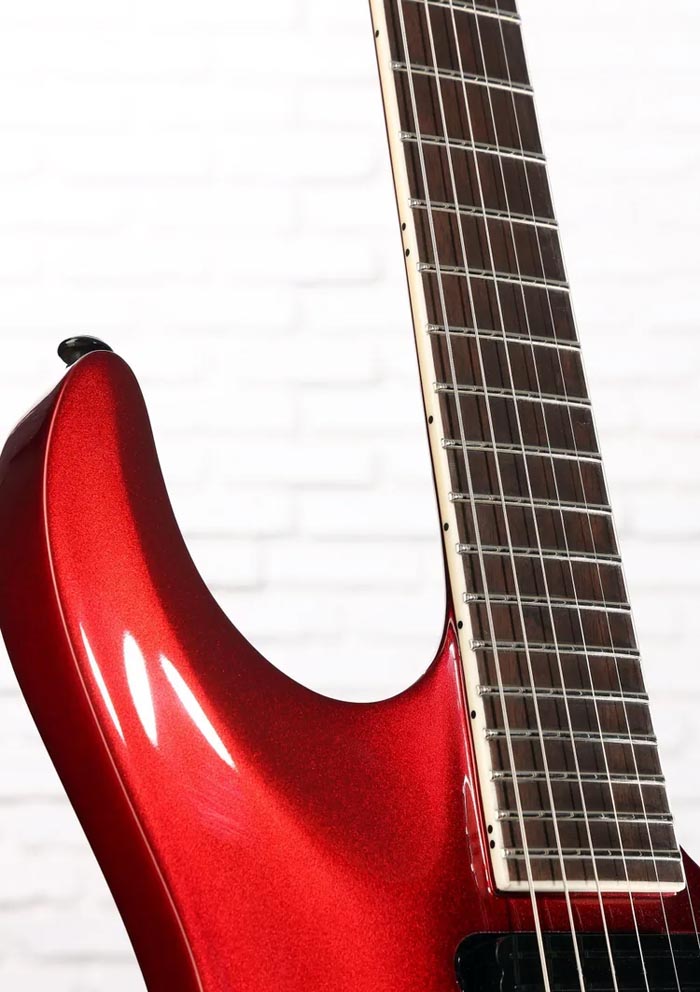
The Horizon Custom ’87 uses a three-piece maple neck with neck-thru construction. The Macassar ebony fingerboard has a 25-1/2″ scale length. ESP gives the neck its Extra Thin U profile, and the fingerboard uses a 350mm radius with 24 extra-jumbo frets.
Anyone familiar with ESP’s high-performance necks will immediately understand the basic approach. The profile is thin and fast, but it does not feel insubstantial. There is enough material in the neck to give the instrument some substance while still allowing the fretting hand to move easily through the neck.
The 350mm radius is also well suited to the design. It is flat enough to accommodate aggressive bending and fast playing while remaining comfortable for conventional chord work. The 24 extra-jumbo frets provide plenty of room for bends and vibrato. The scale length keeps the instrument firmly in familiar Fender territory.
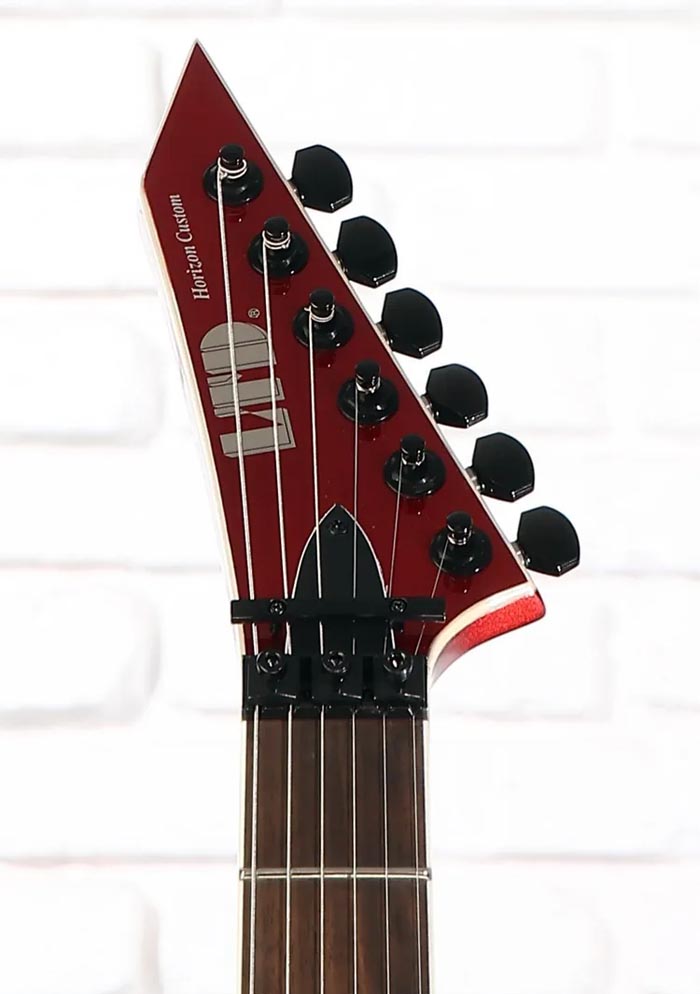
The Macassar ebony fingerboard is another detail that works particularly well here. ESP left the face of the fingerboard without conventional inlays and used side position markers instead. That approach is faithful to the late-’80s Horizon and gives the instrument a cleaner appearance.
It also suits the guitar’s intended personality. The fingerboard does not need a bunch of decoration to tell the player what this guitar is about.
The fretwork on the review instrument was excellent, which ties back into the unusually good setup. There were no obvious rough fret ends or other issues requiring immediate attention. The combination of the thin neck, large frets and smooth ebony board makes the guitar particularly comfortable for players who spend a lot of time working in the upper registers.
For a design that originated more than three decades ago, the playing experience remains remarkably relevant.
ELECTRONICS — High Output, No Nonsense
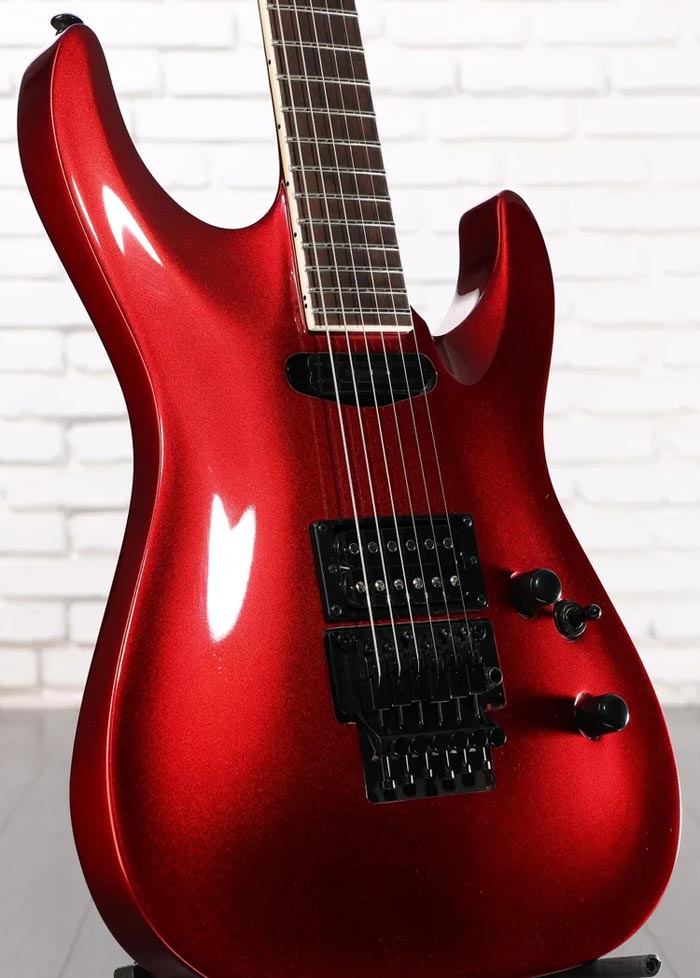
ESP selected a Duncan Custom for the bridge and a Hot Rails for the neck.
The electronics are controlled with a master volume, master tone and three-way toggle switch. The tone control is push-pull, allowing the pickups to be split for additional tonal options.
As with most coil-splitting arrangements, I would treat this as an expansion of the guitar’s vocabulary rather than a claim that the pickups suddenly become vintage single coils. The split sounds provide useful alternatives when less output or a somewhat leaner sound is appropriate. The fundamental personality of the guitar, however, remains that of a high-performance instrument. That is entirely appropriate.
One thing I appreciate about the Horizon Custom ’87 is that ESP did not turn the electronics into a control panel. There are no unnecessary switches or complicated wiring schemes to distract from the basic functionality of the guitar. The controls are straightforward, and the player can get from a rhythm sound to a lead sound without needing a diagram taped to the back of the guitar.
For a guitar based on a late-’80s design, that simplicity feels particularly appropriate.
HARDWARE — Lock, Load and Dive Bomb
The LTD Horizon Custom ’87 comes equipped with a Floyd Rose 1000 double-locking tremolo and locking nut, along with LTD tuners and black hardware on the Candy Apple Red model.
A Floyd Rose is not an optional accessory on a guitar like this. It is part of the design’s original purpose. The Horizon came out of the same period in which the Floyd Rose had become one of the defining pieces of equipment for high-performance guitarists. Replacing it with a conventional bridge would change an important part of the instrument’s identity.
The Floyd Rose 1000 is a sensible choice for the LTD version. It is not the German-made Original Floyd Rose, and players who want the highest-specification version of the hardware can certainly make that argument. At the same time, the 1000-series unit on this guitar has performed exactly as expected. And I have no complaint about its operation.
More importantly, the tremolo arrived properly set up. That matters because a poorly adjusted Floyd can turn a perfectly good guitar into an afternoon of profanity and Allen wrenches. Fortunately, none of that was necessary here.
The locking nut and tuners round out a hardware package that suits the instrument. ESP did not create the appearance of a high-performance guitar while cutting corners on the components that actually make it function.
SPECS
| Specification | Details |
|---|---|
| Construction | Neck-Thru |
| Scale | 25.5″ |
| Body | Alder |
| Neck | 3 Piece Maple |
| Neck Profile | Extra Thin U |
| Fingerboard | Macassar Ebony |
| Radius | 350 mm (13.8″) |
| Frets | 24 XJ Stainless Steel |
| Nut | Locking, 42 mm |
| Bridge | Floyd Rose 1000SE |
| Tuners | LTD |
| Bridge Pickup | Seymour Duncan Custom TB-5 |
| Neck Pickup | Seymour Duncan Hot Rails |
| Controls | Master Vol/Tone w/ P-P Coil Split, 3-Way Toggle |
| Finish | Candy Apple Red, Black, Pearl White |
DEMO
LTD Horizon Custom ’87 | ESP Guitars
LTD Horizon Custom ’87 Demo by Brett Vaughn | ESP Guitars
Sammy Duet (Goatwhore) Reacts to the LTD Horizon Custom ’87 | ESP Guitars
AREAS OF OPPORTUNITY — The Little Things
There really isn’t much to put here, which is a good problem to have.
If I were specifying the guitar for myself, I would probably step up from the Floyd Rose 1000 to the Original Floyd Rose. I am willing to pay a little more for the top-tier version of the tremolo. But I also understand that the LTD line is designed to bring this level of instrument to a more accessible price point. The 1000 is a perfectly appropriate choice for the Horizon Custom ’87.
My bigger concern is that ESP now lists the Horizon Custom ’87 among the discontinued ’87 Series models. That is a shame because this guitar occupies a very useful place between the LTD line and the considerably more expensive ESP Horizon. It gives a beginner ready to step up, a budget-conscious player, or a working musician who would rather take a $1,500-ish guitar to the gig than worry about a $5,700 instrument getting introduced to a stage floor, a genuinely excellent option.
If there is an opportunity here, it is simply to keep making them.
FINAL THOUGHTS — A Horizon Worth Having
The LTD Horizon Custom ’87 is an exceptionally convincing interpretation of one of ESP’s most important designs. The archtop body, neck-thru construction, thin maple neck, ebony fingerboard, and Floyd Rose 1000 all work together as they should. And the excellent setup on my example only strengthened the impression.
Having owned a Kramer Stagemaster Deluxe I since 1989, I am comfortable saying that anyone looking for that particular combination of body shape, feel and attitude should have the Horizon Custom ’87 very high on the list. An original Stagemaster remains the obvious choice for someone who absolutely has to have the original. While the ESP Horizon is the step up for players who want the top of the line. The LTD sits nicely between those two options.
The June 2026 one retailer’s $600 price reduction made this particular guitar an especially easy decision. But I would have been happy with it at its regular price. If ESP has indeed finished production of the Horizon Custom ’87, I hope that decision gets reconsidered. This is not simply a nostalgic recreation of an ’80s guitar. It is a genuinely excellent high-performance instrument that happens to carry a very good piece of ESP history with it.
For reference, this ESP LTD Horizon Custom ’87 guitar evaluation was conducted with a Fractal Axe-Fx II XL+ featuring Celestion Impluse Responses and Fractal MFC-101 MIDI Foot Controller. Real cabs in use are Marshall 1960B, Mojotone British, and Peavey 6505 cabs loaded with Celestion Classic Series Vintage 30s and Classic Series G12M Greenbacks.
ESP Guitars Website | Facebook | Twitter | YouTube | Instagram
7 string 59 Airbucker Alnico 2 Alnico 3 Alnico 4 Alnico 5 Alnico 8 Bare Knuckle BKP Brown Sound Celestion Ceramic Charvel Custom Shop David Shepherd DiMarzio Dual Resonance Edge EVH Fishman Floyd Rose Gibson HSP90 Humbucker Ibanez JB Jimmy Page John Petrucci MJ Mojotone P90 PAF Pariah Pickup Satch Satriani Seymour Duncan Singlecoil Single Width Speaker Steve Vai Tech Tip Tremolo Virtual Vintage