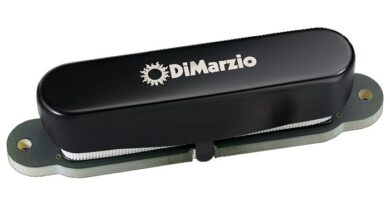
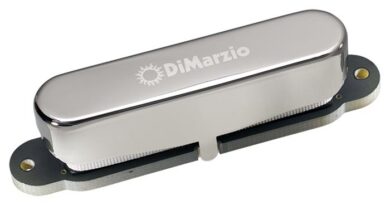
DiMarzio Fast Track T
The Tele Twang Gets a Rail Job
A Telecaster bridge pickup has a pretty recognizable job. It needs snap and twang, but it also needs enough body to keep that brightness from becoming thin or harsh. The traditional recipe does all of that well, although it brings the familiar single coil hum along for the ride.
The DiMarzio Fast Track T takes a different approach. Instead of building another conventional Tele bridge pickup, DiMarzio uses a side by side humbucker with twin blade poles. The goal is more output and a bigger sound while keeping enough of the familiar Tele attack to make the pickup feel at home under a Tele bridge.
That makes the Fast Track T an interesting match for the Fender Squier Classic Vibe 50s Telecaster used here. The guitar has a pine body, maple neck and maple fingerboard, along with Gotoh locking tuners and a DiMarzio 4 Way Tele Wiring Harness.
The neck pickup isn’t part of this evaluation. The focus stays on the Fast Track T and what happens when a rail style hum cancelling pickup takes over the bridge position.

Quiet, Tight and Not Trying Too Hard
DiMarzio has been making the Fast Track T since the 1990s. The pickup uses a ceramic magnet, twin blade pole pieces and four conductor wiring in a side by side humbucker format. It occupies a different part of DiMarzio’s Tele lineup than the Chopper T and Tone Zone T. Those push harder toward the fat and powerful side of the humbucker spectrum. The Fast Track T keeps more of the Tele’s natural personality in the mix, and DiMarzio has put it into some interesting hands over the years.
The company’s artist listings include Fall Out Boy’s Joe Trohman, Earth guitarist Dylan Carlson, fusion player Brett Garsed and Richie Kotzen among the players associated with the Fast Track T. That’s a pretty wide spread of musical territory for one Tele bridge pickup. Alternative rock and fusion to Kotzen’s blues and hard rock vocabulary. Player comments tend to echo the same basic characteristics, with twang, clarity and hum cancellation coming up regularly. Some players looking for a warmer or thicker humbucker sound have preferred something else. But the Fast Track T isn’t really chasing that target. It gives a Tele more room to move without losing the attack that makes the bridge position worth having in the first place.

Dual Resonance
Fast Track T uses DiMarzio Dual Resonance design, which changes the way the coils interact with each other.
Dual Resonance is basically mis-matched coils. It’s common for several pickup companies to allow about a 5% variance. But Dual Resonance is an intentional mis-matching of the coils to produce a specific “tuning” of the pickup’s voice. According to the patent, it is pretty much about putting a similar number of turns on each coil. But with different wire gauges.

Under the Hood
The Fast Track T fits the bridge position of the Classic Vibe 50s Telecaster without requiring the guitar to become anything other than a Tele. The four conductor lead also provides the wiring flexibility needed for different switching arrangements. The Fast Track T remains the focus rather than the wiring becoming a separate project.
The guitar itself provides a useful environment for the pickup. The pine body and maple neck and fingerboard keep the basic recipe close to the sound most players expect from a traditional Tele. The Gotoh locking tuners take care of tuning stability. The DiMarzio 4 Way Tele Wiring Harness provides 250K volume and tone controls along with the additional switching options.
Those 250K controls deserve some attention. DiMarzio specifically gives the Fast Track T different tonal recommendations depending on control resistance. The company describes 250K as the warmer option, while a 500K volume control and 1 Megohm tone control open the pickup up considerably.
The 250K setup makes sense in this particular guitar. The maple neck and fingerboard already provide plenty of attack, and the Fast Track T has a strong treble response in DiMarzio’s published tone chart. There is no obvious reason to throw more high end at the guitar simply because the pickup can handle it.

Clean Enough to Stay Tele
The Fast Track T keeps enough of the familiar Tele attack that the bridge position doesn’t lose its identity. The notes arrive quickly, chords stay articulate and the upper end provides the snap needed for the usual Tele vocabulary. It doesn’t reproduce every little characteristic of a vintage single coil. But it doesn’t sound like a generic humbucker wearing a Tele bridge as a disguise either.
The biggest difference shows up underneath that initial attack. There is more body behind individual notes. The bass feels tighter than the loose, slightly ragged low end that some vintage Tele bridge pickups can produce. That gives clean chords more substance without taking away the definition that makes the bridge position useful.
The 250K controls also keep the Fast Track T from becoming excessively sharp. The maple neck and fingerboard contribute plenty of immediacy. The control value keeps the pickup’s upper end from dominating the sound. The result has enough brightness to sound lively without requiring the player to apologize to anyone standing in front of the amplifier.
The player feedback I found generally supports that balance. Fast Track T owners repeatedly describe the pickup as retaining Tele characteristics while adding warmth, clarity and hum cancellation. Some players have found it less warm than they wanted, particularly when comparing it with a full sized humbucker. But that difference makes sense given what DiMarzio designed the pickup to accomplish.
Once the Amp Gets Dirty
The extra body becomes more useful as the amplifier moves into overdrive. The Fast Track T pushes the front end harder than a typical vintage Tele bridge pickup, but it doesn’t produce the huge midrange hump associated with some of DiMarzio’s more aggressive Tele humbuckers.
That keeps the pick attack present when gain starts filling in the spaces between notes. Palm muted riffs have enough low end to feel solid. Individual notes retain the edge that helps them cut through a distorted sound. Chords also keep more of their internal definition than they would with a pickup that pushes harder into compression.
This gives the Fast Track T a fairly broad working range. It can handle clean Tele parts without sounding out of place, then move into classic rock and harder rock territory without requiring the player to change guitars. The pickup doesn’t need extreme output to make that transition work.
The 250K Decision
The Fast Track T gives the player more control over its personality than the pickup’s basic specifications might suggest. DiMarzio recommends 250K controls for a warmer sound and higher resistance values when more high end and twang are wanted. That makes the control circuit an important part of the final result rather than an afterthought.
The 250K setup in this Tele keeps the Fast Track T on the more balanced side of that equation. The guitar already has plenty of maple in the construction, so adding additional brightness through a 500K volume control isn’t necessary to make the bridge position lively.
That doesn’t mean the Fast Track T lacks high end. Quite the opposite. The pickup has enough snap that the bridge position remains immediately recognizable, and rolling back the tone control gives plenty of room to move toward a thicker sound when needed.
The higher resistance options would make more sense for a player who wants to push the Fast Track T further toward the cutting, aggressive side of its personality. In this guitar, the 250K controls give it enough edge without making the top end the entire story.
No Hum, No Problem
The hum cancelling design becomes increasingly useful once gain enters the picture. A traditional Tele bridge pickup can sound fantastic through a clean amplifier and then become considerably less charming when the gain goes up. The Fast Track T doesn’t bring that particular baggage along for the ride.
The side by side humbucker design removes the familiar single coil noise while keeping the pickup’s response relatively open. There is no need to accept a heavily compressed or overly dark bridge sound simply to get away from the hum.
That matters more than the specification sheet might suggest. The Fast Track T can sit in front of an overdriven amplifier without turning the noise floor into another part of the performance. You still get the Tele attack, but the pickup doesn’t require the same compromises when the rig gets louder and dirtier.

Specs
DCR – 5.871 K
Inductance – 2.312 H
Split – 3.617 K
Split – 2.252 K
Parallel – 1.3897 K
Output – 191 mV
Magnet – Ceramic

Demo
Conclusion
The Fast Track T gives a Tele bridge position a little more room to stretch without losing the attitude that brought you to a Tele in the first place. It adds enough muscle for overdrive and higher gain, keeps the attack lively, and removes the hum that can make a traditional bridge pickup frustrating once the volume goes up. The result doesn’t feel like a compromise between a Tele pickup and a humbucker. It feels more like a Tele that has been given some extra options.
That makes the Fast Track T an easy pickup to live with in a guitar like this Classic Vibe 50s Telecaster. The 250K controls keep the top end in check, while the pine body and maple neck let the pickup retain plenty of snap and definition. Players looking for every last bit of vintage Tele roughness have plenty of other choices, but anyone wanting to push a Tele further into rock territory without losing its basic personality gets a lot of useful ground from the Fast Track T.
For reference, this DiMarzio Fast Track T pickup evaluation was conducted with the following: Fractal Axe-Fx II XL+ featuring Celestion Impulse Responses and Fractal MFC-101 MIDI Foot Controller. ADA MP-1 Tube Pre-Amp loaded with Tube Amp Doctor ECC83 Premium Selected tubes, using the ADA MC-1 MIDI Controller. Fryette LX II Stereo Tube Power Amplifier. Physical cabs use are Marshall 1960B, Mojotone British, and Peavey 6505 cabs loaded with Celestion Classic Series Vintage 30s and Classic Series G12M Greenbacks.
DiMarzio Website | Facebook | Twitter | YouTube | Instagram
7 string 59 Airbucker Alnico 2 Alnico 4 Alnico 5 Alnico 8 Artist Signature Bare Knuckle BKP Brown Sound Celestion Ceramic Charvel Custom Shop David Shepherd DiMarzio Dual Resonance Edge EVH Fishman Floyd Rose Gibson HSP90 Humbucker Ibanez JB Jimmy Page John Petrucci MJ Mojotone P90 PAF Pariah Pickup Rail Satch Seymour Duncan Singlecoil Single Width Speaker Steve Vai Tech Tip Tremolo Virtual Vintage