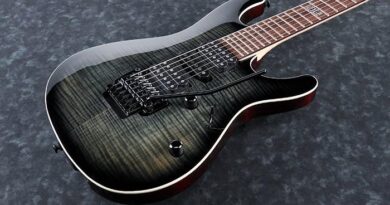
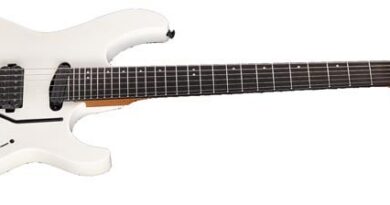
Ibanez JS240PS
The Legacy Continues
Few signature guitars have stood the test of time like the Ibanez JS series.
Since its introduction in the early 1990s, Joe Satriani’s signature model has never relied on gimmicks or extravagant cosmetics to earn its reputation. Instead, the JS platform evolves through careful refinement. Every contour serves a purpose. Every specification reflects decades of real world experience from one of rock’s most respected instrumentalists. That philosophy continues with the Ibanez JS240PS.
Introduced as part of the Premium Series, the JS240PS brings many of the defining characteristics of Satriani’s higher end signature models to a more approachable price point. Built in Indonesia, it pairs the familiar basswood body with a maple and bubinga neck, a rosewood fingerboard, the legendary Edge double locking tremolo, DiMarzio pickups, and perhaps its biggest attraction, a factory installed Sustainiac system.
On paper, it reads like everything a modern JS should be. The obvious question is whether the experience lives up to the specification sheet. Can a Premium Series instrument deliver the refined feel that has defined the Japanese built JS models for decades? Or do cost cutting measures reveal themselves once the honeymoon ends?
After spending some time with the JS240PS, I came away with an answer that surprised me more than once.

Two Guitars. One Story.
Transparency is important when evaluating any instrument, and the JS240PS reviewed here actually involved two different guitars.
The first example arrived with several issues that prevented it from receiving a fair evaluation. The most significant was unusually high action at the nut. Further inspection revealed that the locking nut was not sitting flush against the nut shelf, which appeared to be caused by the mounting hardware preventing proper seating.
Additional inspection uncovered a bent spring retainer beneath the tremolo block, mismatched screws, and an area inside the tremolo cavity that appeared to have been relieved by hand for additional clearance. None of these issues affected basic operation, but together they suggested this particular instrument had slipped through quality control.
Rather than judge the entire JS240PS platform based on an obvious outlier, the guitar was returned to the retailer.
The replacement arrived in excellent condition and provided a much clearer representation of the model. Fit and finish were impressive, hardware was properly installed, and the guitar required only minor setup adjustments before evaluation.
The remainder of this review is based entirely on that second instrument.

First Contact
The Ibanez JS240PS does not rely on extravagant appointments to make an impression. Finished in Candy Apple with chrome hardware, it has a refined appearance that fits naturally within the Joe Satriani signature family. The design is unmistakable, but it avoids unnecessary decoration and keeps the focus on the shape of the instrument. That shape carries decades of history.
The JS platform traces its roots back to the Ibanez Radius Series, a model Joe Satriani adopted before working with Ibanez to refine it into something uniquely his own. Rather than reinventing the design, the changes focused on subtle improvements that made an already comfortable guitar even more ergonomic. The smoother contours and refined transitions helped create the identity that has defined the JS series ever since.
Those refinements are immediately noticeable when the guitar is strapped on. The rounded body edges, forearm contour, and rear carve allow the instrument to sit comfortably against the player without the sharper contact points found on many traditional superstrats. Despite the 24 fret neck and double locking tremolo, the JS240PS feels compact and balanced in both seated and standing positions.
The basswood body continues the approach that has worked well throughout the JS series. It provides a comfortable weight while maintaining enough resonance and response for both clean and high gain playing. Combined with the excellent finish work, clean hardware alignment, and careful assembly of the replacement instrument, the JS240PS presents itself as a well considered performance guitar designed around playability first.
That focus remains one of the defining characteristics of the JS family.

The Foundation
The JS240PS follows a formula that has served the JS family well for decades, but its success depends on execution rather than specification. On paper, basswood, a bolt on maple and bubinga neck, and a rosewood fingerboard aren’t particularly exotic. Together, however, they create an instrument that feels remarkably cohesive.
Basswood has been unfairly dismissed over the years as nothing more than an inexpensive tonewood, yet guitars like this continue to challenge that perception. The body resonates freely, with an even response that avoids emphasizing one frequency range over another. Chords retain excellent clarity, while single notes bloom naturally without becoming overly compressed or brittle.
The sculpted body contributes just as much to the playing experience as the wood itself. The forearm bevel naturally supports the picking arm, while the rear contour keeps the body comfortably against the player. Even after extended sessions, the guitar remains remarkably comfortable, with very few pressure points reminding you that you’ve been wearing it for hours.
Access to the upper register is equally impressive. The generous lower horn cutaway and sculpted neck heel allow all twenty four frets to remain comfortably within reach. Whether navigating melodic passages or stretching into the highest register for sustained leads, the guitar never feels like it’s working against the player.
Like many premium instruments, the JS240PS eventually fades into the background. Instead of constantly reminding you that you’re holding a guitar, it allows your attention to shift entirely toward making music. That’s one of the highest compliments an instrument can receive.

Built For Velocity
Joe Satriani is not known for relying on exaggerated neck dimensions to achieve speed. His signature neck reflects that philosophy.
The JS240PS features the familiar JS three piece maple and bubinga neck with a comfortable oval profile that immediately feels inviting. Rather than chasing extremes, it settles into a middle ground that accommodates a wide range of playing styles. Fast alternate picking, wide interval stretches, legato passages, and chord work all feel equally at home.
The satin finish deserves special recognition. Your fretting hand glides effortlessly along the neck without the sticky sensation often associated with heavy gloss finishes. Whether practicing at home or playing beneath hot stage lighting, movement remains smooth and predictable.

The 250 mm (9.8″) fingerboard radius also deserves mention because it takes a different approach than many modern superstrats. Rather than adopting an ultra flat profile, Ibanez stays remarkably close to the traditional 10 inch radius found on countless Stratocasters, Telecasters, and even many Gibson models. The result feels instantly familiar. Chords remain comfortable in the lower register, while bends higher up the neck still have plenty of room to sing without feeling cramped. It’s a specification that strikes an excellent balance between old school comfort and modern performance.
Neck stability inspires equal confidence. The three piece maple and bubinga neck already provides an exceptionally rigid foundation, but Ibanez goes a step further by incorporating KTS titanium reinforcement rods beneath the fingerboard. The added rigidity helps resist seasonal movement while maintaining a lively, responsive feel. During the evaluation, the neck remained consistently stable, requiring no unexpected adjustments. While every wooden instrument will respond to changes in temperature and humidity, this construction gives every indication of being built for years of dependable service.

Precision Under Pressure
Excellent fretwork often goes unnoticed, and that’s exactly how it should be. The replacement JS240PS arrived with cleanly dressed fret ends, smooth crowns, and consistent leveling across the fingerboard. There were no high frets to chase, no rough edges to distract from aggressive bends, and no unexpected dead spots anywhere on the neck.
Medium frets continue to be an excellent match for the overall personality of the guitar. They provide enough height for expressive bending and vibrato without making the playing experience feel disconnected from the fingerboard. Intonation remains predictable, while wide bends maintain excellent control.
The Prestige line still enjoys a reputation for some of the finest fretwork in the industry, and understandably so. Even so, the Premium Series makes a compelling case for itself here. Unless both guitars are sitting side by side, many players would be hard pressed to identify meaningful differences in day to day playing. That says as much about the quality of the Premium Series as it does about the evolution of modern manufacturing.

The Flight Controls
For many players, the Edge tremolo alone is reason enough to consider the JS240PS. Decades after its introduction, it remains one of the finest double locking tremolo systems ever installed on a production guitar. Smooth operation, impressive tuning stability, and a natural feel under the hand continue to set it apart from many competing designs.
Flutter techniques come effortlessly. Wide pull ups remain stable, while deep dive bombs return to pitch with reassuring consistency. Even subtle vibrato feels remarkably fluid, making the bridge just as expressive during slower melodic passages as it is during more aggressive playing.
The Edge also benefits from thoughtful ergonomics. The low profile baseplate stays comfortably out of the picking hand’s way, while the arm tension allows the tremolo to remain exactly where it’s placed instead of constantly falling toward the floor.
One feature unique to the JS240PS is the Ultralite tremolo arm. While not stock on this model, I did purchase it separately to better understand what Satch is going for. Compared to a traditional steel arm, the composite construction reduces weight without sacrificing rigidity. Whether players ultimately prefer it will come down to personal taste, but after spending time with it, the lighter feel quickly becomes natural and never gives the impression of being fragile.
Hardware throughout the remainder of the guitar maintains that same attention to detail. The Gotoh machine heads operate smoothly, strap buttons feel secure, and every control moves with reassuring precision. Nothing feels inexpensive and nothing interrupts the playing experience.

The Engine Room
The electronics package is where the JS240PS separates itself from many other signature models. Joe Satriani’s relationship with DiMarzio has always been built around refining specific tools for his playing style, and this guitar follows that same approach with a combination designed for both traditional tones and extended sustain effects.
At the bridge position, the JS240PS features the DiMarzio Satchur8 humbucker. Rather than relying strictly on output, it emphasizes clarity, articulation, and dynamic response. Since I recently published a dedicated review of the Satchur8, I won’t revisit every detail here. Instead, it’s enough to say that it complements the overall character of the JS240PS extremely well, providing everything from articulate rhythm work to smooth, singing lead tones.

The Sustainiac
While the bridge pickup handles traditional duties, the neck position takes an entirely different approach.
Instead of a conventional humbucker, Ibanez equips the JS240PS with a Sustainiac driver paired with the specially customized “Stealth PRO” preamp. This system provides the near endless sustain that has become closely associated with Joe’s signature sound while offering additional harmonic modes through the three way selector.
The Sustainiac system is one of those features that can appear somewhat specialized on paper, but its usefulness becomes much clearer once the guitar is in hand. With the system disengaged, the JS240PS behaves like a familiar dual humbucker style instrument, with the bridge pickup handling traditional lead and rhythm duties. Engaging the Sustainiac opens up an entirely different set of possibilities, allowing notes to continue blooming long after the initial attack.
The three position mode selector adds another layer of control. Natural sustain mode delivers the expected endless sustain effect, while the harmonic modes introduce textures that move beyond what a standard pickup configuration can provide. Players who enjoy atmospheric leads, controlled feedback, or long evolving phrases will quickly discover why this system has remained part of Joe’s toolkit for so many years.
What makes the implementation successful is that the Sustainiac does not make the JS240PS feel like a one trick instrument. It expands the guitar’s vocabulary without limiting its usefulness when the effect is not active. That balance is important because the best signature instruments don’t force players into the artist’s style. They provide the tools and allow players to develop their own voice.

Numbers Behind the Music
neck type: JS 3pc Maple/Bubinga w/ KTS TITANIUM rods
top/back/body: American Basswood body
fretboard: Rosewood fretboard / White dot inlay
fret: Medium frets / Premium fret edge treatment
number of frets: 24
bridge: Edge bridge
string space: 10.8mm
neck pickup: Sustainiac Driver neck
bridge pickup: DiMarzio Satchur8 bridge
hardware color: Chrome
Neck Deminsions
Scale : 648mm/25.5″
Width at NUT: 42mm
Width at 24F: 56mm
Thickness at 1F: 20mm
Thickness at 12F: 22.3mm
Radius : 250mm
Switching System / Controls


From The Hands Of Satch
Here is an early introduction of the guitar when it was the JS240P, prior to the Sustainiac and Satchur8 additions:
Where It Could Be Better
The JS240PS succeeds because Ibanez resists the temptation to overcomplicate the formula. The guitar delivers the essential elements that define Joe Satriani’s signature models keeping the instrument within reach of players who may not be ready to step into the Made In Japan price range. That balance does come with some considerations that are worth understanding before making a purchase.
The most obvious differences between the JS240PS and its higher end Japanese counterparts come down to refinement rather than design. Players who have spent time with the Japanese instruments may notice subtle differences in areas such as final fret finishing, cosmetic detailing, and the last degree of hand refinement that comes from a flagship production line.
Those differences are an expectation at this price point, but they do not diminish what the JS240PS accomplishes. This guitar does not feel like a compromised version of a Made In Japan model. Instead, it feels like a thoughtfully positioned instrument that captures the core JS experience while making practical concessions to reach a wider audience.
Personally, I still find myself gravitating toward the all passive configuration of the JS2450. The Sustainiac simply falls outside the way I normally use a guitar. That said, after spending considerable time with the JS240PS, I came away appreciating the system far more than I expected. The bigger surprise, however, is the value proposition. Considering the significant price difference between the JS240PS and its Japanese counterparts, I never found myself feeling shortchanged. Unless the Prestige refinements or an all passive configuration are absolute requirements, the JS240PS makes a remarkably convincing case for itself.
The Final Chord
The Ibanez JS240PS proves that a signature guitar doesn’t have to appeal only to collectors or devoted Joe Satriani fans. Like every JS before it, this guitar is built around balance. It favors comfort over flash, expression over excess, and versatility over specialization. Those qualities are what have kept the JS platform relevant for more than three decades, and they remain just as evident here.
The JS240PS carries that philosophy forward with an impressive combination of familiar JS ergonomics, reliable hardware, versatile electronics, and the added creative possibilities of the Sustainiac system. While the Premium Series construction reflects its price point, the core experience remains unmistakably JS.
For guitarists looking for a comfortable, expressive, and highly versatile instrument, the JS240PS represents one of the strongest entries in the Ibanez Premium Series. It delivers the character that has made the JS family a favorite for decades while opening that experience to a wider range of players.
For reference, this Ibanez JS240PS guitar evaluation was conducted with a Fractal Axe-Fx II XL+ featuring Celestion Impluse Responses and Fractal MFC-101 MIDI Foot Controller. Real cabs in use are Marshall 1960B, Mojotone British, and Peavey 6505 cabs loaded with Celestion Classic Series Vintage 30s and Classic Series G12M Greenbacks.
Ibanez Website | Facebook | Twitter | YouTube | Instagram
Look for my other IBANEZ content HERE
7 string 59 Airbucker Alnico 2 Alnico 3 Alnico 4 Alnico 5 Alnico 8 Bare Knuckle BKP Brown Sound Celestion Ceramic Charvel Custom Shop David Shepherd DiMarzio Dual Resonance Edge EVH Fishman Floyd Rose Gibson HSP90 Humbucker Ibanez JB Jimmy Page John Petrucci MJ Mojotone P90 PAF Pariah Pickup Satch Satriani Seymour Duncan Singlecoil Single Width Speaker Steve Vai Tech Tip Tremolo Virtual Vintage