ESP LTD GL Desert Eagle
First Impressions
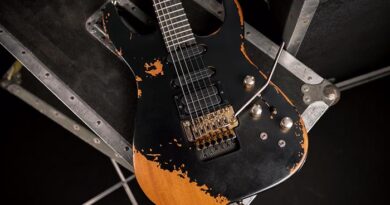
The Desert Eagle makes its entrance with a legacy already built in. George Lynch has been tied to ESP for about forty years. His first signature with the company was the now legendary Kamikaze. I am the original owner of a 1991 Kamikaze 3 (desert camo). The Desert Eagle takes that original concept and reimagines it. Ttrading in the combat theme for a design that reflects Lynch’s deeper artistic vision and cultural influences.
Opening the case, the first thing that hits you is how bold the guitar looks without sliding into gimmick territory. The artwork draws from Native American inspiration, with a desert toned palette that feels both raw and refined. It is immediately recognizable as part of the Lynch lineage. But distinct enough to stand on its own as a new chapter.
What really stands out in these first moments is how serious the Desert Eagle feels. This is not a fan club novelty or a nostalgia piece. It looks and feels like a guitar meant for players who expect an instrument to work as hard as they do. The vibe is professional, dangerous, and ready for the stage.

Body
The LTD Desert Eagle comes dressed in alder. This immediately sets it apart from the pricier ESP Custom Shop version that uses maple. Now, let me say this as someone who owns a pair of the full-blown maple-body Lynch models. Alder just makes more sense here. It shaves off some weight, so you are not feeling like you strapped on a marble countertop for a two-hour set. And it delivers a tonal response that is more accessible in the real world. Maple can be a little unforgiving, a little too much in your face. Alder still gives you punch and snap. But with a touch of warmth that makes the guitar a little more versatile in a mix.
The contouring is comfortable, the balance is right, and the Desert Eagle wears that custom paint job without feeling like it is trying too hard. This is a guitar that wants to live on a strap and be played standing up, not just sit around as wall art for fanboys.
Another practical bonus is that this LTD version uses a traditional electronics cavity instead of the old ESP trick of stuffing parts in like a hot-rod wiring experiment. That means easier access, quicker swaps, and simpler service down the road. I appreciate the legacy of the higher-end models. But I will gladly take a guitar that lets me get in and out of the wiring without cursing at a Friday night solder job.

Electronics
The Desert Eagle ships with a setup that is simple but effective, which is very much in line with how Lynch likes to run his rigs. The star of the show is the stock ESP LS 120 single coil in the neck position. It is shockingly good, with a clear and articulate voice that still has enough body to avoid sounding thin. It is one of those pickups that makes you forget it is “stock,” because it just flat out works.
The controls are minimal, just a push-pull volume pot that doubles as the pickup selector. The factory 500k pot is fine and does the job, and the unbranded quarter-inch output jack is perfectly serviceable. That said, I went ahead and swapped in a Pure Tone output jack. If you are going to have only one control on the entire guitar, you might as well make sure every bit of that signal path is bulletproof.
Now, here is where things got a little spicy. The ’78 Model bridge humbucker that came stock in my Desert Eagle sounded weak and anemic right out of the gate. A check with the meter confirmed the suspicion: only one coil was working?!? That is not something you expect from Duncan. While that falls on the pickup itself, it is worth noting that the guitar still passed both ESP LTD’s factory QC and the retailer’s 55-point inspection. That is two sets of eyes that somehow missed a humbucker firing on half power. To their credit, ESP is being quick to respond and is replacing the pickup, so customer support appears to be coming through.

Hardware
The Floyd Rose 1000SE on my Desert Eagle showed serious wear right out of the case. The pivot points were already chewed up, and tuning stability was nowhere to be found. That kind of damage happens when someone adjusts the action with the system under full string tension. That is rule number one of what not to do with a Floyd. Whether this happened at the factory or during the retailer’s 55-pt inspection, it somehow made it through two sets of QC. To their credit, ESP stepped up quickly and is arranging a replacement.
Chasing down the tuning issue revealed an even bigger surprise at the other end. The locking nut was loose enough to shift during dive bombs. And worse, it had been installed cockeyed with a 1/16″ gap on the high E side. In forty years of playing Floyd Rose systems, I have never seen a nut mounted that poorly.
I ended up fixing it myself by drilling, plugging, and re-setting the pilot hole so the nut could sit flush against the fretboard. It works as it should now. But it is not the sort of repair you expect to be doing on a brand new signature model. The hardware on my Desert Eagle is the weak link. And while ESP’s customer service handled it, these issues should have never left the factory floor.

Neck
The Desert Eagle comes with the GL Original U profile. That feels like a Strat thickness with a little extra shoulder. It fills the hand without being a baseball bat, and it gives players a comfortable anchor for both rhythm work and lead runs. Add in the clever twist of pairing an R3 Floyd Rose nut with a neck that is about a millimeter wider on each side. You get a little more real estate for advanced shred techniques. That extra width is subtle but noticeable, especially when precision is the name of the game.
Fretwork is generally solid, with only a few frets sitting a hair tall here and there. Nothing drastic enough to call for a full level and crown, and certainly not something that gets in the way of playability. What does deserve a nod is the truss adjustment wheel at the base of the neck. Coming from older ESP models like my ’91 Kamikaze and mid-90s Sunburst Tiger, both of which require removing the neck to tweak relief, this update feels like a small miracle.
One surprise was the presence of whiskers on the back of the neck, which usually points to wood that was worked a little too soon. A quick pass with 0000 steel wool fixed it easily. But in over four decades of playing I cannot recall ever needing to do that on a brand new guitar. The neck itself is strong and fast, but little lapses like this are another reminder that the Desert Eagle sometimes leaves the factory before it is fully ready for battle.

Specs
Construction: Bolt-On
Scale: 25.5″
Body: Alder
Neck: Maple
Fingerboard: Macassar Ebony
Fingerboard Radius: 305mm
Finish: Desert Eagle Graphic
Nut Width: 43mm nut / 45mm neck width
Nut Type: Locking
Neck Contour: GL Original U
Frets/Type: 22 XJ Stainless
Hardware Color: Black
Strap Button: Standard
Tuners: LTD
Bridge: Floyd Rose 1000SE
Neck PU: ESP LS-120
Bridge PU: Seymour Duncan ‘78
Electronics Layout: Volume(Push/Pull)
Case: ST-TE GUITAR FORM FIT CASE
Case Included: Y
Electronics: Passive

Demo
Areas of Opportunity
The Desert Eagle makes a strong first impression, but there are a few places where the execution could have been sharper. The most obvious were the hardware issues, from the worn Floyd Rose baseplate and posts to the cockeyed locking nut. Both problems are fixable, and ESP’s support has been responsive. But they are the kind of slip-ups that should never make it out of the factory or past a retailer’s inspection.
Electronics were mostly solid, though my bridge humbucker arrived with only one coil firing. Again, ESP stepped in quickly to offer a replacement. It is still surprising to see a malfunctioning pickup make it through multiple checkpoints. On the flip side, the stock LS 120 single coil proves ESP can absolutely deliver a great in-house pickup.
Fit and finish on the neck is close to excellent, though the presence of whiskers on the back stood out. It was an easy fix, but it is not the kind of detail players expect to be addressing on day one. Smoothing out those small QC issues would make the Desert Eagle feel every bit as professional as its design and legacy deserve.

Conclusion
The Desert Eagle is a guitar with real presence. It brings the Kamikaze’s long history with ESP full circle. A reimagining of a signature model in a way that feels both familiar and fresh. It takes the DNA of the original Kamikaze and presents it in a way that feels modern, playable, and purpose-built. The alder body gives it a more approachable tone and weight. The LS 120 single coil shines, and the neck profile is built for players who actually want to dig in. Toss in a legit ESP-branded $200 hard case, and the $1700 price tag starts to make sense.
Yes, the QC on my example left room for improvement. But ESP’s support was quick to step up. Once corrected, the Desert Eagle proves to be a solid instrument with a lot to offer. For players chasing that Desert Eagle vibe, this is a signature model that can deliver serious results with just a little fine-tuning. With tighter QC, it could stand as one of the strongest LTD signature models in recent memory.
For reference, this ESP LTD GL Desert Eagle evaluation was conducted with the following: Fractal Axe-Fx II XL+ featuring Celestion Impluse Responses and Fractal MFC-101 MIDI Foot Controller. ADA MP-1 Tube Pre-Amp loaded with Tube Amp Doctor ECC83 Premium Selected tubes, using the ADA MC-1 MIDI Controller. Fryette LX II Stereo Tube Power Amplifier. Physical cabs in use are Marshall 1960B, Mojotone British, and Peavey 6505 cabs loaded with Celestion Classic Series Vintage 30s and Classic Series G12M Greenbacks.
ESP Guitars Website | Facebook | Twitter | YouTube | Instagram
7 string 59 Airbucker Alnico 2 Alnico 4 Alnico 5 Alnico 8 Artist Signature Bare Knuckle BKP Brown Sound Celestion Ceramic Charvel Custom Shop David Shepherd DiMarzio Dual Resonance Edge EVH Fishman Floyd Rose Gibson HSP90 Humbucker Ibanez JB Jimmy Page John Petrucci MJ Mojotone P90 PAF Pariah Pickup Rail Satch Seymour Duncan Singlecoil Single Width Speaker Steve Vai Tech Tip Tremolo Virtual Vintage